
Chris Hornung
February 24, 2018
Page 5
February 24, 2018
Page 5
Maker Spotlight:
The History of A.J. Reach & Co.
The History of A.J. Reach & Co.








Generational Transition
By 1905, multi-millionaires Al Reach (president) and Ben Shibe (vice president) had handed responsibility for the day-to-day operations of A.J. Reach & Co. to their sons, George A. Reach (treasurer) and Thomas S. Shibe (secretary). Tom managed Reach's baseball department while George oversaw mitt and glove manufacturing. Reach's Kensington factory now employed over 1,200 workers who produced fielder's gloves, catcher and 1st base mitts, masks, chest protectors, footballs, punching bags, boxing gloves, and between 3,000,000 and 4,000,000 baseballs each year.
Of this transition, a March 4, 1905 article in St. Louis Sporting News surmised, "It is better for the father to train his sons correctly while he is alive than to let them take hold in ignorance after he is gone, and make a mess of things, as they often do when the direction of affairs is steadfastly kept from them till the last minute and they must step in and assume charge of an establishment that has been built up and maintained on a paying basis mainly through hard work on the part of their predecessors. In this case, as in countless others, in which young blood has been introduced into the management of great industries, success has been enjoyed in an increasing measure. Old heads are there to advise and counsel, but young hands grasp the steering wheel, and who shall say that the mantle has not fallen on worthy shoulders? [18]"
Of this transition, a March 4, 1905 article in St. Louis Sporting News surmised, "It is better for the father to train his sons correctly while he is alive than to let them take hold in ignorance after he is gone, and make a mess of things, as they often do when the direction of affairs is steadfastly kept from them till the last minute and they must step in and assume charge of an establishment that has been built up and maintained on a paying basis mainly through hard work on the part of their predecessors. In this case, as in countless others, in which young blood has been introduced into the management of great industries, success has been enjoyed in an increasing measure. Old heads are there to advise and counsel, but young hands grasp the steering wheel, and who shall say that the mantle has not fallen on worthy shoulders? [18]"
Shibe Park
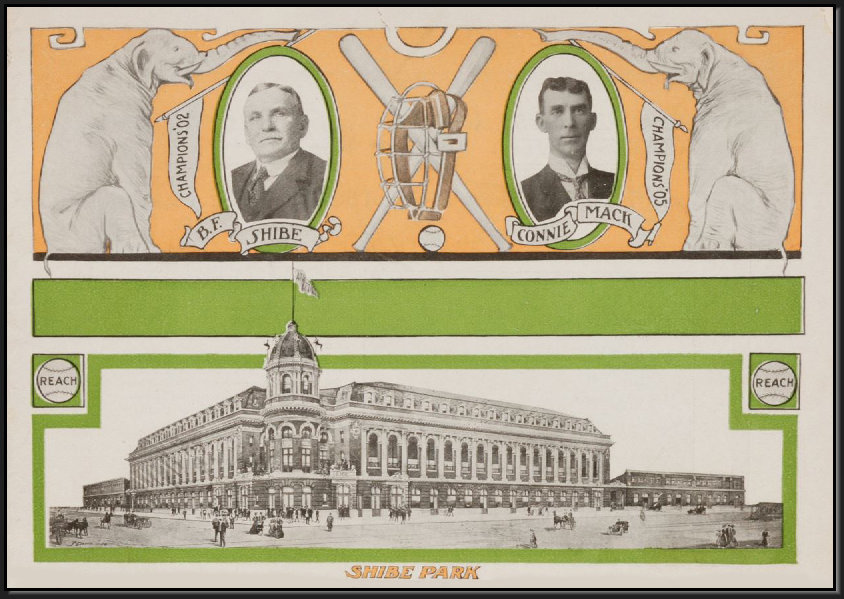
In 1901, Ben Shibe and Connie Mack leased land in the Brewerytown section of Philadelphia for the construction of the Athletics new home, Columbia Park. The modest 9,500-seat ballpark cost $35,000, and became the site of Athletic excellence. The club won the American League pennant in 1902 and in 1905, when they would go on to lose the World Series to the New York Giants. Despite expanding the stadium's capacity to 13,600 in 1906, the club routinely couldn't accommodate the deluge of fans who showed up to purchase tickets.
In 1907, Shibe covertly assembled 5.75 acres of land 5 blocks west of the Baker Bowl for $67,500. The site would become "Shibe Park," a 23,000-seat stadium that Ban Johnson called "the greatest place of its character in the world. [19]" Designed by William Steele & Sons, Shibe Park achieved a masterful balance between French Renaissance architecture and state-of-the-art, modern fireproof construction. The building's ornate facade and slate mansard roof hid the stadium's internal reinforced concrete and steel structure. An iconic octagonal cupola at the intersection of Lehigh Avenue and 21st Street sat atop the Athletics management offices, where Shibe's sons Jack and Tom along with Connie Mack, managed the day-to-day operations of the club.
Estimated to cost between $300,000 and $500,000, the stadium paid immediate dividends after opening on April 12, 1909. The Athletics won the American League pennant in 1910, 1911, 1913, and 1914, and were World Series Champions in 1910, 1911, and 1913.
In 1907, Shibe covertly assembled 5.75 acres of land 5 blocks west of the Baker Bowl for $67,500. The site would become "Shibe Park," a 23,000-seat stadium that Ban Johnson called "the greatest place of its character in the world. [19]" Designed by William Steele & Sons, Shibe Park achieved a masterful balance between French Renaissance architecture and state-of-the-art, modern fireproof construction. The building's ornate facade and slate mansard roof hid the stadium's internal reinforced concrete and steel structure. An iconic octagonal cupola at the intersection of Lehigh Avenue and 21st Street sat atop the Athletics management offices, where Shibe's sons Jack and Tom along with Connie Mack, managed the day-to-day operations of the club.
Estimated to cost between $300,000 and $500,000, the stadium paid immediate dividends after opening on April 12, 1909. The Athletics won the American League pennant in 1910, 1911, 1913, and 1914, and were World Series Champions in 1910, 1911, and 1913.
During baseball's "dead-ball era" (1900-1918), rules changes, evolving strategies, and larger ballparks lead to the decline of batting averages, home runs, and team scoring. Another culprit was the design and overuse of baseballs. The rubber core within the baseball flexed upon impact, allowing the woolen yard wound around it to loosen incrementally with each impact. As it loosened, the amount kinetic energy converted from bat speed to ball distance diminshed. By 1908, the league-wide batting average had dropped below .240, and the league sought ways to improve offensive output.
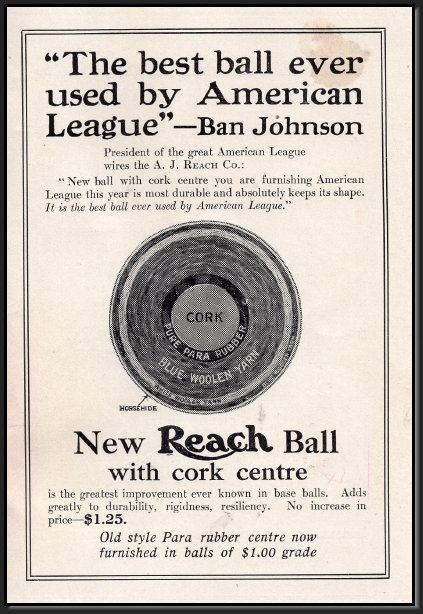
In 1909, Benjamin Shibe was issued U.S. Patent 932,911 for a new baseball designed to increase liveliness, the "cork centre" baseball. Shibe's design replaced the standard baseball's para rubber core with a cork sphere, upon which strands of india-rubber were wound, baked at 264 degrees Fahrenheit for forty-five minutes, and then dipped in a rubber cement. The new core was lighter, yet more rigid and resilient, which provided a firmer base upon which the woolen yarn was wound. According to the Sporting Life in 1910,
In 1909, Benjamin Shibe was issued U.S. Patent 932,911 for a new baseball designed to increase liveliness, the "cork centre" baseball. Shibe's design replaced the standard baseball's para rubber core with a cork sphere, upon which strands of india-rubber were wound, baked at 264 degrees Fahrenheit for forty-five minutes, and then dipped in a rubber cement. The new core was lighter, yet more rigid and resilient, which provided a firmer base upon which the woolen yarn was wound. According to the Sporting Life in 1910,
Cork Centered Baseball
In 1912, A.J. Reach catalogs and advertisements began listing a new production facility in Toronto, Canada. Information on this facility is scant, but it is probable that the plant produced sporting goods primarily for the Canadian market, likely in response to international tariffs which made importing American goods to Canada less profitable. A.G. Spalding and Wright & Ditson also listed manufacturing facilities in Canada around the same timeframe. By 1917, the Reach plant had been relocated to Brantford, Ontario where, in addition to baseball and football goods, produced hockey, skating, skiing and other winter sporting goods.
Ontario Factory
A.J. Reach Official American League Baseball Guide, 1909
A.J. Reach Official American League Baseball Guide, 1910
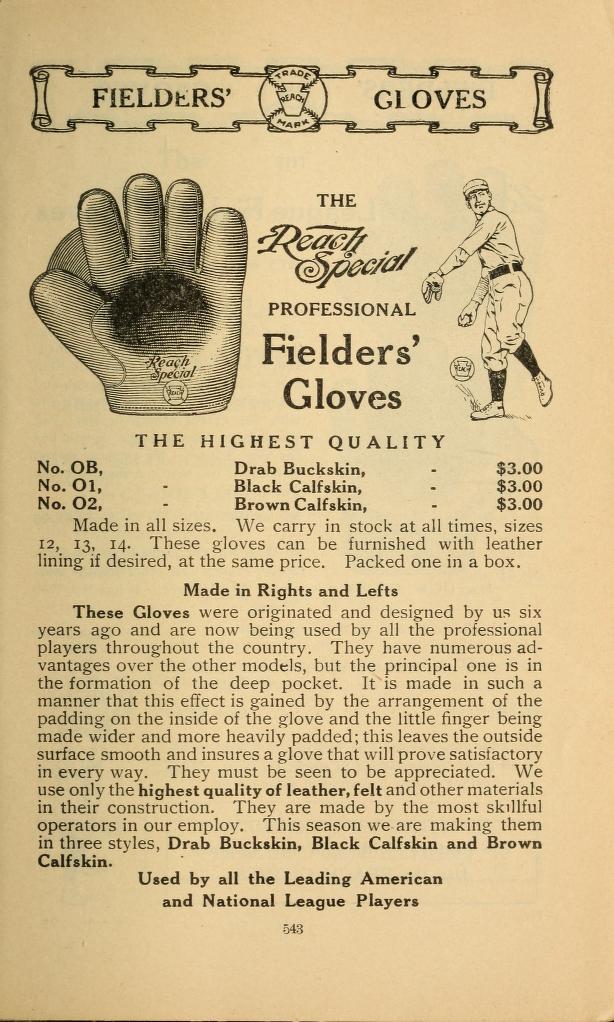
A.J. Reach Official American League Baseball Guide, 1906
The ball made an immediate impact. American and National League batting averages improved to .273 (1911) and .272 (1912), respectively. Runs per game increased from 3.83 in 1910 to 4.51 in 1911. Perhaps the most recognizable difference ushered in by Shibe's new ball was the distinct crack made when the ball was struck, a sound that has delighted baseball fans ever since.
"The lighter cork center compels tighter wrapping in order to make up the loss of weight in the'same sized ball. The tighter wrapping prevents the handicapping later-inning ‘mushiness' and the crack of impact is as sharp in a ball used through eight innings as at the start. Of course the pitchers don’t like it, but the spectators — especially those who have been clamoring for increased batting, will notice the improvement and rejoice accordingly. [23]"
Two-League System
After two years spent battling over territories and players, by 1902 it had become evident to National League executives and team owners that Johnson's upstart American League wasn't going away. In part due to signing many of the National League's former stars, American League teams enjoyed equal, and in many cases, superior attendance than their National League counterparts. National League owners won court injuctions preventing some remaining players from defecting to the American League, but faced an impending crisis as player contracts approached the end of their terms, at which point bidding wars would ensue.
From the Sporting Life and the A.J. Reach Official American League Base Ball Guide, Frank Richter was an outspoken advocate for a two-league professional baseball system, the adoption of a reserve clause, and the reform of baseball rules. Reach and Shibe lent their voices to the effort, believing it would bring stability to professional baseball and that Philadelphia could support two teams. True to this belief, in 1903 Shibe graciously allowed the Phillies to play at the Athletics ballpark while their own underwent repairs.
In September 1903, the two leagues signed the National Agreement for the Government of Professional Base Ball Clubs. Its provisions included the establishment of a three-member National Commission charged with adjudicating disagreements between clubs and players. In addition, it standardized player contracts to include a reserve clause, and setup an annual championship game between league champions, the World Series.
From the Sporting Life and the A.J. Reach Official American League Base Ball Guide, Frank Richter was an outspoken advocate for a two-league professional baseball system, the adoption of a reserve clause, and the reform of baseball rules. Reach and Shibe lent their voices to the effort, believing it would bring stability to professional baseball and that Philadelphia could support two teams. True to this belief, in 1903 Shibe graciously allowed the Phillies to play at the Athletics ballpark while their own underwent repairs.
In September 1903, the two leagues signed the National Agreement for the Government of Professional Base Ball Clubs. Its provisions included the establishment of a three-member National Commission charged with adjudicating disagreements between clubs and players. In addition, it standardized player contracts to include a reserve clause, and setup an annual championship game between league champions, the World Series.
Philadelphia Athletics Program, 1909, Heritage Auctions
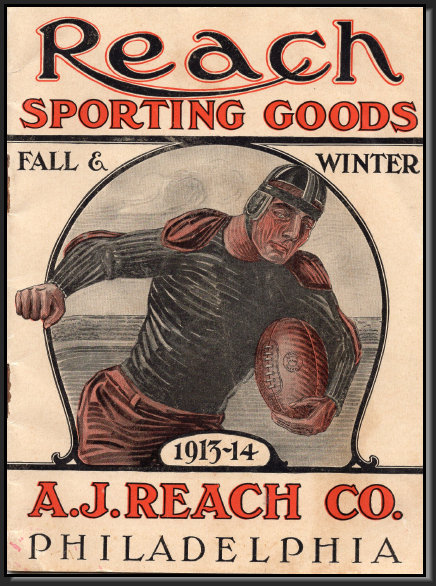
A.J. Reach & Co. Fall & Winter Catalog, 1913-14
REFERENCES
