







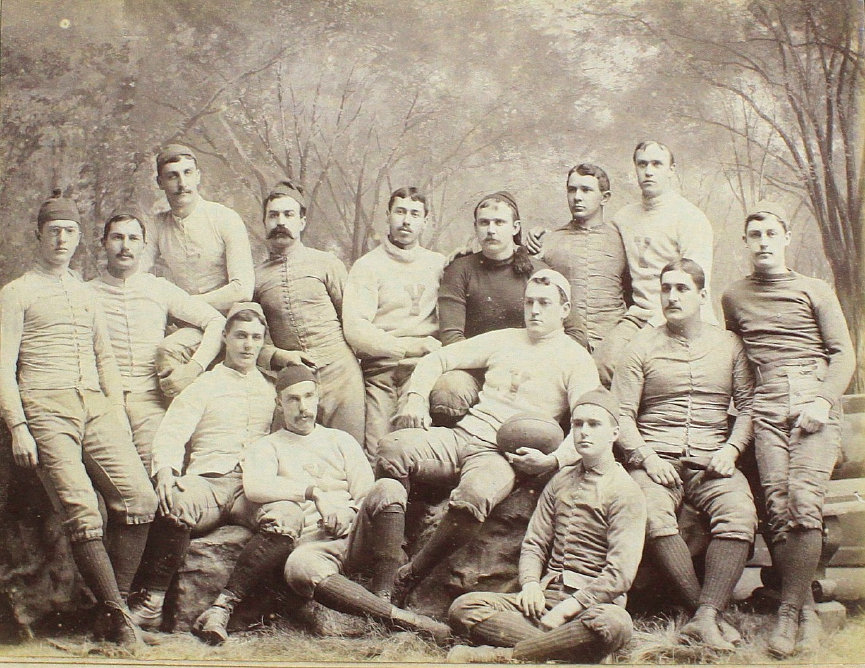
Based on photographic records, football headgear in the mid-1880's wasn't standardized equipment within teams either. In many photos, such as those of the 1885 Princeton and 1884 Yale football teams below, players on the same squad wore multiple styles of caps, including solid and multi-colored Eton caps, visored jockey caps, skull caps, and a new variation that first appeared around 1881, commonly referred to today as the "stocking cap." Similar to the skull cap, the stocking cap was manufactured of worsted wool, but extended into a conical shape, often adorned with a decorative tassel. In 1880's catalogs, the stocking cap was referred to by a variety of names, including the long cap, the club cap, the football toque, and the Roman cap.
The Stocking Cap
The Football Cap Page 3
Chris Hornung
March 4, 2020
March 4, 2020
1876 Yale Football Team
1878 University of Pennsylvania Team Photo, University of Pennsylvania University Archives
While skull caps were the most prevalent football headgear in the late 1870's and early 1880's, their use at the collegiate level was by no means monolithic. Headgear was not required by rule, leaving each team their choice of cap style and whether to wear them at all. The University of Michigan football team wore striped pillbox caps during their 1879 campaign while the 1878 and 1879 University of Pennsylvania team chose Eton-style caps with visors.
1879 University of Michigan football team
1885 Princeton Football Team
1884 Yale University Football Team
1888 Johns Hopkins Football Team
A series of evolutionary changes to American football throughout the 1880's eventually led to the decline of the football cap. First, the codification of the line of scrimmage in 1880 changed the nature of contact in the sport by eliminating the rugby scrum, a primary source of cranial friction that necessitated head protection in the first place. Second, the introduction of downs in 1888, requiring teams to advance 5 yards in 3 downs, favored a more open style of play. The massive entanglements of manhood that typified the early game (and warranted a football cap) gave way to more frequent open field collisions for which the football cap provided little protection. Finally, players seeking more freedom of movement to compete in this new style chose to remove the sleeves from their football jackets or wear the "football jacket without sleeves," that domestic sporting goods manufacturers began introducing in the late 1880's. The sleeveless jacket allowed jerseys to become more prominent and reduced dependence on football caps for player identification.
Football Caps, Daniell & Sons