
Questions or comments? Please email me at:
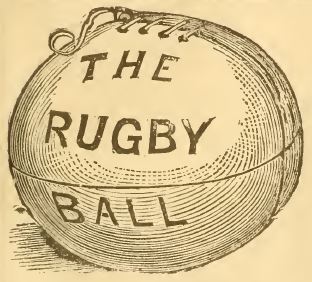
Balls sold for American football were referred to as "rugby balls" or "rugby foot balls" by sporting goods manufacturers until around 1910. Beginning in 1910, manufacturers dropped "rugby" and simply used the term "football". Therefore, early melon footballs are occasionally found with "Rugby" embossed in the leather.
Occasionally, modern rugby balls are marketed for sale on auction sites as "melon footballs." Typically these balls are less than 50 years old. There are several tell-tale signs that a ball is a modern rugby ball and not a melon football:
1. 6 Laces - While a handful of early melon football manufacturers used a 6 lace pattern, most used a 7 or 8 lace pattern.
2. Round or oval stitching around the laces - Very few melon footballs had oval stitch patterns around their laces. Nearly every vintage or modern rugby ball utilized this pattern.
3. Center valve hole - Modern rugby balls typically have a protruding valve stem in the center of the laces. In some cases, sellers will remove the valve and bladder. Look for a round cut out in the leather where a valve stem would protrude.
Occasionally, modern rugby balls are marketed for sale on auction sites as "melon footballs." Typically these balls are less than 50 years old. There are several tell-tale signs that a ball is a modern rugby ball and not a melon football:
1. 6 Laces - While a handful of early melon football manufacturers used a 6 lace pattern, most used a 7 or 8 lace pattern.
2. Round or oval stitching around the laces - Very few melon footballs had oval stitch patterns around their laces. Nearly every vintage or modern rugby ball utilized this pattern.
3. Center valve hole - Modern rugby balls typically have a protruding valve stem in the center of the laces. In some cases, sellers will remove the valve and bladder. Look for a round cut out in the leather where a valve stem would protrude.
A Word on Rugby Balls
Circa 1903-1908 Spalding Rugby Football Box
Circa 1905 Reach Rugby Match Ball
Modern rugby football
Modern rugby football
Bundgaard, Axel. <i>Muscle and Manliness: The Rise of Sport in American Boarding Schools</i>. Syracuse, NY: Syracuse UP, 2005. Print.
References
The Ball that Shaped the Game...and Vice Versa
The Evolution of the Football
Chris Hornung
June 20, 2015
Page 4